

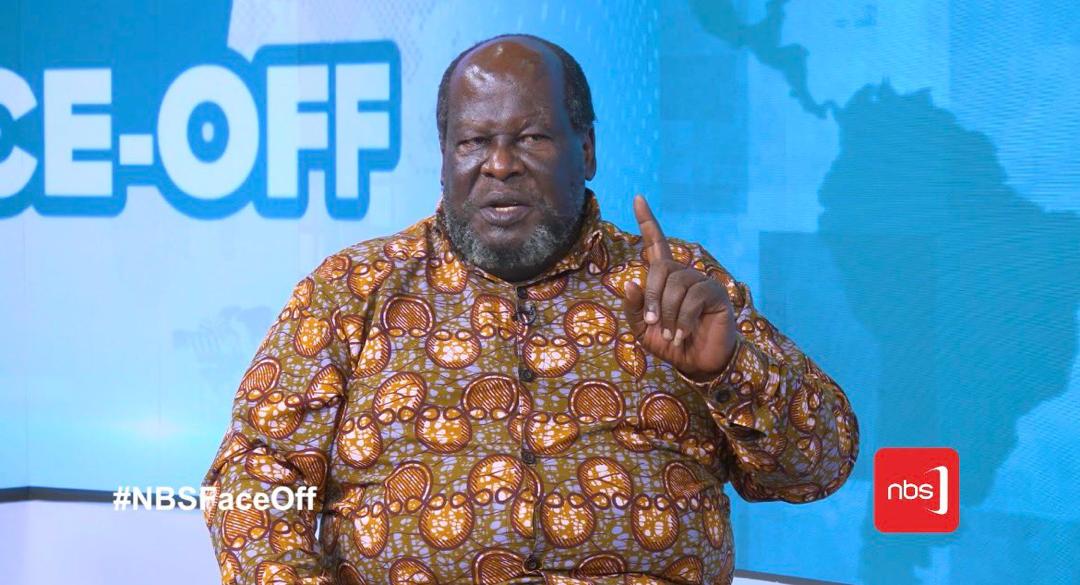
Former Leader of Opposition (LoP) in Parliament, Prof. Morris Ogenga Latigo, has delivered a wide-ranging critique of Uganda’s parliamentary practice, electoral integrity, and governance model, urging deeper national reflection and elder-led dialogue to chart the country’s future ahead of the forthcoming presidential and parliamentary elections.
Speaking to Canary Mugume on NBS Face Off on Sunday, Latigo reflected on his tenure as LoP and contrasted it with the current state of Parliament and national politics. He recalled that during his time in office, accountability and responsiveness were central to the opposition’s role.
“When I was the Leader of Opposition, whenever the President made his State of the Nation Address, I would immediately respond after the budget speech. In my statement, I would focus on the President’s key messages and provide a critique,” he said.
Latigo noted that Parliament benefited from principled leadership at the time, particularly from the late Prime Minister Apolo Nsibambi, who served as Leader of Government Business.
“In my time, the country was lucky to have the late Professor Apolo Nsibambi. He was a distinguished Ugandan citizen,” he said.
Turning to the current Parliament, Latigo described what he termed a “tragedy” in institutional independence and checks and balances.
“If you want to see the tragedy of this Parliament, the Leader of Opposition has the mandate to appoint who sits on the Parliamentary Commission,” he said, suggesting that the system has drifted from its intended oversight functions.
Latigo also expressed deep concern over the state of Uganda’s electoral process, arguing that elections have progressively deteriorated, particularly at presidential and parliamentary levels.
“Many things have changed, and our elections are getting worse and worse. I lost twice not because my people didn’t want me, but because the system ensured I was knocked off,” he said.
Highlighting the untapped potential of the Ugandan diaspora, Latigo argued that political uncertainty discourages investment and return.
“What transformed India and China are diaspora people. Uganda has huge potential in the diaspora. They will not come home and invest if there is uncertainty about the future,” he said.
Criticizing centralized decision-making under President Museveni, Latigo noted that overreliance on presidential direction undermines institutional governance and long-term planning.
“The problem with this kind of government, where even something as small as PDM must originate from the President rather than from a line ministry, is that you cannot predict or project when that leadership ends,” he said.
On the prospect of a national dialogue, Latigo called for a process guided by elder statespersons rather than political aspirants.
“At a national dialogue level, Bobi Wine would be a small kid—and he is. It would be adults—the elders of Uganda—who should lead that dialogue. Young people can present their views, but the way forward must be driven by people who have no self-interest,” he emphasized.
